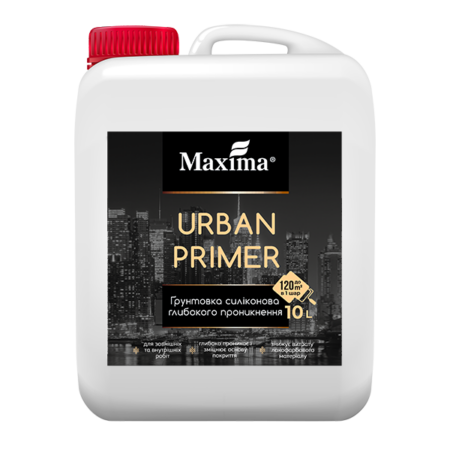
Specification
- it penetrates deeply and hardens the base surface
- it lessens water permeability of the base surface without significant effect to vapor permeability of a complex coating.
Sphere of application
It is intended for improving adhesion, hardening and leveling of absorption of different surfaces (bricks, concrete, slag block, concrete stuccos, chip wood boards, MDF, gypsum boards and other porous surfaces) before performing of any finishing works with a plaster or putty, coating with acrylic or silicon waterborne products inside and outside.
Content
Technical data
| Consumption standard of 1 layer | 80-125 g/m2, it depends on condition and structure of the surface. |
| Thinner | Water |
| Application | It is applied with a roller, a brush or a spraying gun. |
| Drying period (23 °С, 50% RH) | 1 hour. Drying period increases if the temperature is getting down and relative air humidity is increasing. |
| Solids content (DSTU ISO 3251) | 6±1 % |
| Density (DSTU ISO 2811-1) | ≈ 1 g/сm3 |
| Warranty period | 18 months from the date of manufacturing (at the temperature from +5 °С till +35 °С) |
| Packaging | 2kg (≈ 2l), 10kg (≈ 10l) |
Color
Application instruction
The guarantee of the desired result is following the directions for applying the paint product and preparing the surface.
1. Surface preparation
The preparation of the base surface is carried out according to DSTU-N B A.3.1-23:2013 and DSTU-N B V.2.6-212:2016.
The surface shall be dry - the humidity of the base surface shall be less than 5% before priming for cement and cement-sand base surfaces, and less than 1% for gypsum. Wet surfaces don't allow the primer to absorb, thereby reducing its hardening ability.
The surface must be clean from chalk and lime whitewashings, grease and oily stains, and other contaminations, efflorescences, dust (including abrasive dust after plaster polishing), old paint products, wallpapers, polymeric adhesives, composits and construction mortar runs.
Mineral-based surfaces shall be hard, without fragile parts or edges. The material of the surface and all plaster, stucco, insulating or adhesive elements shall be completely dry and be ready for priming.
Areas affected by mould or fungi must be removed: first, mechanically with special tools, and then treated with antiseptic for mineral surfaces TM Farbex.
Remove contaminations, infections, old coatings, or fragile parts with a wire brush, spatula, scratcher, or by machine.
Renovate uneven surfaces with plaster TM Farbex (depending on their nature).
Metal elements on the surface shall be made of galvanized or stainless steel. If you use iron elements, you must protect them against corrosion with special primers or other products.
Before using subordinate products (glue, antiseptic, stucco, etc.), we recommend checking compatibility on a small area of the surface, following technical directions or specialist advice.
Follow thoroughly technical recommendations (especially during drying period or subsequent treating) for further priming and decorating with constructive mortars or products. For example, cement plasters shall be treated not before 4 weeks after application, fresh concrete - 3 months, and the surface of the insulating system - 7 days.
2. Applying
Stir the primer thoroughly before use. The primer is ready to use and needs no dilution. Filter it if necessary.
Very absorbing surfaces must be treated in 2 coats with an intermediate drying period of 2 hours (drying period between priming coats increases if the temperature falls, and relative air humidity rises. The consumption of the primer also matters.) Check the condition of the surface after every primer application to make sure if the next coat is necessary.
Carry out works at the temperature of the air and the surface from +10 ºС to +30 ºС and relative air humidity less than 80% (the temperature of the surface shall be 3 degrees higher dew point).
Remember! Mineral surfaces are porous materials, so the consumption of the product and the quantity of coats can increase.
Do not prime under direct sunlight, strong wind, frost and precipitation. A primed surface shall not be affected by precipitation or subsero temperatures until finishing coating is not applied.
Subsequent works shall be carried out after 5 hours from the last applied primer coating.
Deep-penetrating silicone primer can be applied as follows:
|
Application method |
Quantity of thinner |
Jet size |
Pressure |
|
Airless spraying |
It needs no diluting! |
"0,007 - 0,011" |
15 МПа (≈ 150 bar) |
|
Pneumatic spraying |
1,2 – 1,4 mm |
0,3 – 0,5 mPa (≈ 3-5 bar) |
|
|
A brush / a roller |
- | - |
The tool shall be recommended for WB products.
We recommend using a cuvette when working with a roller for homogeneous wetting of the tool.
When you use a spraying gun for application, follow the directions for exploitation.
For a quality coating, you shall obtain painting skills, especially when you use professional tools.
We do not recommend overpriming the base surface. To avoid these effects, we recommend test application of all materials on a small area of the surface or "testing stand".
Attention! A primer provides no hydroisolating and antiseptic properties and doesn't protect against biocorrosion. Do not use for priming metal and wooden surfaces!
The primer is not a finishing product; it must be protected with finishing products. The primer cannot be used as a tinting base.
When applying outdoors (facade works), we recommend carrying out work using a tent for "coverage of facades and building constructions".
Compatibility with other coatings
Depending on the conditions of exploitation, the primer can be used together with various finishing coatings. The examples of compatibility are mentioned below. If you need more precise information, call the specialists of POLYSAN.
Previous coat - we recommend applying it on a clean surface. Subsequent coat - acrylic and silicone water-based products.
We recommend testing compatibility on a small area of the surface.
3. Tool cleaning
Rinse tools with running water after you finish the work. Do not let them get dry.
You may also be interested in
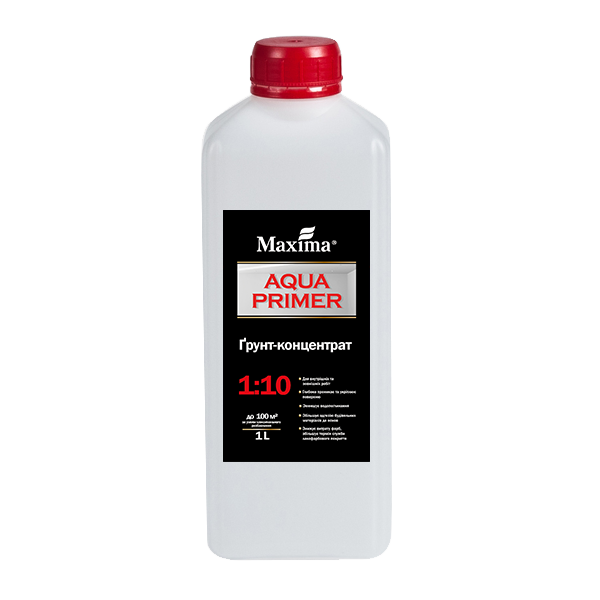
Use with this product
Primers for mineral surfaces Maxima
Primers for mineral surfacesповністю
Flow calculator
Consumption standard of 1 layer
When calculating the area to be painted, you need to subtract the area that will not be painted. (windows, doors, etc.)
Paint consumption may vary depending on dilution and uniformity of application of the paint.