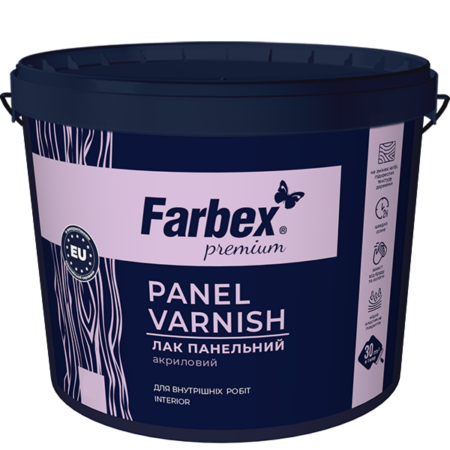
Specification
It is intended for interior work. It forms a strong elastic film. It reliably protects the surface, preserves its natural color and texture. The coating is resistant to wet cleaning and mud. It has high adhesion to the base surfaces. It dries quickly, and it has no strong odor. The product is easy to apply.
Sphere of application
The product is intended for decorative protection of various wooden and mineral surfaces indoors, such as lining, natural wooden boards, skirting, plywood, chipboard, fiberboard, MDF, brick, decorative stone, concrete, plaster, putty, etc. Do not use for varnishing floors and furniture!
Content
Technical data
| Consumption standard of 1 layer | 80-120 g/m2, depending on the type of the surface and method of application. |
| Thinner | Water. Dilution is allowed up to 10% of the total weight of the product. |
| Application | It is applied with a roller, a brush or a spraying gun. |
| Drying period (23 °С, 50% RH) | 2 hours. Drying period increases if the temperature falls and the relative air humidity rises, and it depends on the paint consumption (the coat thickness). |
| Gloss (DSTU ISO 2813) | Glossy. Less than 60 GU at 60° |
| Hardness (DSTU ISO 1522) | Less than 20 sec., Konig pendulum. |
| Solids content (DSTU ISO 3251) | 30±2 % |
| Density (DSTU ISO 2811-1) | 1,02 g/cm3 |
| Warranty period | 24 months from the date of manufacturing (at the temperature +5 °С до +35 °С) |
| Packaging | 0,9 kg, 3 kg, 10 kg |
Gloss
Color
Application instruction
The condition for receiving a desired result is following directions for using the paint product and preparing the surface.
1. Surface preparation
The surface must be dry, thoroughly cleaned until hard base surface from dust, dirt, mould, corrosion, scale, oily, grease and other contaminations and pealed paint coatings.
Use these methods of cleaning: mechanical (a scratcher or wire brush), thermal (a heat gun or infrared radiation), and chemical (paint-removal solutions). Avoid using a cleaning option that can damage the base surface.
The timber humidity before varnishing must be less than 20%.
Remove resin deposits from the surface of the wood mechanically (with a spatula or a scratcher). To make the surface look nice, emphasize the wood pattern, improve coating properties, prolong the exploitation period of the finishing paint product, we recommend polishing the wood along the fibers. Remove the dust after polishing. If wood is infected by blue stain, mould, or fungi, remove infected areas: first mechanically, then treat the wood with antiseptic for wooden surfaces TM Farbex. Correct created uneven areas with Putty TM Farbex. Polish the corrected surface and dust it off.
Hard, previously coated surfaces must be polished and dusted off. It is necessary to achieve the best adhesion of the paint product.
The best decorative look is achieved if the surface is fully cleaned of old coats before coating.
Mineral-based surfaces must be hard, without fragile parts or edges. All surface elements must be fully dry and suitable for coating with water-based products.
Before you use subordinate products (primer, adhesive, antiseptic, etc.), we recommend checking compatibility on a small area of the surface, following all recommendations and hints made by specialists.
2. Priming
Providing maximum exploitation resistance and better decorative effect, depending on the type of surface, it must be primed:
Wooden porous surfaces – with acrylic wood-protective primer TM Maxima. Attention! The primer raises the wood fibers, which is why the surface must be polished before applying the paint.
Mineral surfaces – with acrylic deep-penetrating primer TM Farbex.
Hard types of OSB, wood chip boards, fiber boards, wallpapers, hard old paint coatings need no priming before applying the paint.
Take into account recommendations about priming construction mortars or products. If necessary, call the specialists of POLYSAN.
3. Applying of finishing layer
Before varnishing, make sure that the previous coats of paint products are dry enough. Stir the product thoroughly before use. If necessary, filter the product and dilute it to a workable viscosity (excessive dilution can spoil the product's properties).
Apply the varnish in 2 coats with intermediate polishing. Apply a subsequent coat not before 4 hours. The coating obtains complete hardness and resistance to mechanical load after 14 days.
Carry out the application at the temperature of the air and the surface from + 10 ºС until +30 ºС and relative air humidity less than 80 %. Provide appropriate ventilation at the place during the application and drying of the varnish.
Remember! Wooden and mineral surfaces are porous materials; therefore, the consumption of varnish and the quantity of coats can increase.
We recommend continuously applying in one direction with the same consumption. Carry out the application “from edge to edge (from corner to corner)” or within the limits of the decorative element without breaks. Apply the varnish thoroughly on the edges of the wood, which notably increases its exploitation resistance. When you work on large areas and/or for a long period, we recommend stirring the product from time to time. Do not leave the container with the products open for a long period.
After application, the coating shall not be affected by water and other liquids for 24 hours.
Acrylic panel varnish can be applied by following methods:
|
Method of application |
Quantity of diluent |
Recommendations |
|
Airless spraying |
0 – 5 % |
Jet size: 0,011" – 0,013" Pressure: 15 MPa ( ≈ 150 bar) |
|
Pneumatic spraying |
0 – 10 % |
Jet size: 1,5 – 2,0 мм Pressure: 0,3 – 0,5 Mpa ( ≈ 3 - 5 bar) |
|
A brush |
0 – 5 % |
Plain brush for varnish "Lakra" |
|
A roller |
0 – 5 % |
Paint roller "Velour", nap length 4 – 6 mm. |
The tools must be recommended for water-based products.
When you apply with a roller, we recommend using a cuvette for homogeneous wetting of the tool. Attention! For a smoother coating, we recommend using a roller with a shorter nap.
When you use spraying instruments, follow the instructions for exploitation.
For a quality coating, you must obtain painting skills, especially if you use a professional instrument.
Compatibility with other coatings
Depending on the exploitation conditions, it can be used with different primers and finishing coatings. The examples are stated further. Call the specialists of POLYSAN to receive more detailed recommendations.
Previous coating – alkyd solvent-based products and acrylic water-based products.
Subsequent coating – acrylic water-based products.
Compatibility of products is recommended for testing on a small area of the surface.
4. Tool cleaning
Rinse the tools with water after application. Do not let them dry. Remove hardened varnish mechanically.
Panel varnish Farbex
Choose a high-quality acrylic panel varnish that will provide protection and preserve the aesthetics of wooden surfaces.повністю
Flow calculator
Consumption standard of 1 layer
When calculating the area to be painted, you need to subtract the area that will not be painted. (windows, doors, etc.)
Paint consumption may vary depending on dilution and uniformity of application of the paint.