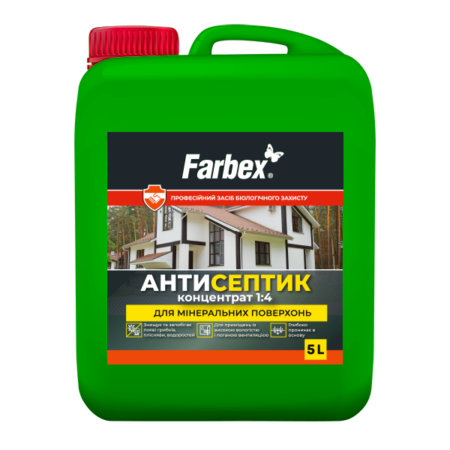
Farbex
Antiseptic conctentrate for mineral and wooden surfaces 1:4
Specification
- it penetrates deeply into the base surface
- it reliably protects against bacteria, mould, and fungi
Sphere of application
Concentrated waterborne product is intended for treating of concrete, brick, stuccos, stone, asbestos concrete and other mineral and wooden surfaces. It disinfects and prevents mould, fungi, algae and other biological damages on the absorbing surfaces before undercoating and coating. It is for external and internal use. It is especially recommended for wet spaces and poor aired spaces.
Content
Technical data
| Consumption standard of 1 layer | 100-125 ml/m2 |
| Thinner | Water. The antiseptic is ready to use. If necessary, dilute as recommended. |
| Application | Apply with a brush, a roller or a spraying gun. |
| Density (DSTU ISO 2811-1) | ≈ 1 g/cm3 |
| Drying period (23 °С, 50% RH) | 1 hour. The drying period increases if the temperature falls and relative air humidity increases. It also depends on the consumption of the product. |
| Warranty period | 24 months |
| Packaging | 1 l, 2 l, 5 l |
Color
Application instruction
The condition for receiving a desired result is following directions for using the paint product and preparing the surface.
1. Preliminary preparation
Remove from the surface blue stain, mould, fungi, and clean all infected areas mechanically before applying the antiseptic for effective use!
The surface shall be dry: for cement and cement-sand base surfaces – less than 5%; for gypsum –less than 1%; wood and timber bases – less than 20%. Attention! High humidity of the base surface lessens the consumption of antiseptic and, as a result, lessens antiseptic efficiency.
The surface must be cleaned from chalk and lime whitewashings, grease, oily and other contaminations, efflorescence, dust, old paint coatings, wallpaper, polymer adhesives, runs of constructive solutions or composites. If treating wooden surfaces, we recommend removing the resin mechanically from the surface (with a spatula or a scratcher).
Mineral surfaces must be hard, without fragile parts and edges.
Before using subordinate products (adhesive, stucco, detergents, etc.), we recommend checking the compatibility on a small area of the surface, following the technical directions and specialists’ hints.
2. Using
Mix the antiseptic before use, but not intensively (just to foam it). The antiseptic is ready to use and need no diluting. Filter it if necessary.
For wooden surfaces as well as for infection prevention of mineral surfaces, dilute the antiseptic with water in ratio: 1 part of the antiseptic to 4 parts of water. In case of severe infection use antiseptic without dilution.
If adding to chalk or cement mortars (consider the antiseptic like water for preparing the mortars for a desired result) Add 80-100 ml of undiluted antiseptic to 1 kg of mortar.
After antiseptic we recommend applying a primer (depending on the base surface), and then finishing products.
Pay special attention to mineral surfaces that mostly contact with moisture and edges of timber until complete saturation.
If treating horizontal surfaces and increased consumption of antiseptic, the full drying of the surface can continue longer.
Carry out works at the temperature of the air and the surface from +5 ºС to +35 ºС and relative air humidity under 80% (the temperature of the surface must be 3 degrees above the dew point). During application and drying of the antiseptic, provide appropriate ventilation.
Carry out treatment in 2-3 applications, providing summary consumption up to 200 ml/m2. Depending on the base surface, apply subsequent coats in 2 hours.
Do not apply the antiseptic under direct sunlight, strong wind and precipitation. The surface must not be affected by precipitation before the application of the finishing coating. Treating frozen wood is prohibited.
Apply subsequent paint products after the surface treated with the antiseptic is fully dry.
We recommend applying the antiseptic with contact methods (a roller, a brush, a sponge), rubbing it into wooden surface. The tools must be recommended for water-based products.
Applying with a roller, we recommend using a cuvette for homogeneous wetting of the tool. When you apply the product by spraying, follow directions for exploitation.
For a positive result you need to obtain painting, finishing or wood treating skills, especially if you use professional instrument.
We recommend treating wooden surfaces along the timber fibers!
The consumption of antiseptic and the effect of “impregnation” substantially depend on the the texture and material of the base surface. When you work with unusual or specific base surfaces, you must do the test application of all coats of protective coating on a small area, following all requirements.
Other additional recommendations when you work with the antiseptic for mineral surfaces.
The antiseptic is not a finished product and must be protected with coatings. The antiseptic is not suitable for tinting.
The antiseptic raises the timber fibers. After the application, the surface must be polished, dusted off, and then you can apply other coatings.
After treating, we recommend using nails, staples, and screws made of galvanized or stainless steel. If there are elements of black metal in wooden constructions, we must protect them against corrosion in prior with special primers or other products.
When you apply the product on the surface, the foam can appear! In this case, remove the foam with a wet cloth or a brush.
Do not use containers or tools that can be affected by corrosion.
Compatibility with other coatings
Depending on the condition of exploitation, the antiseptic can be used with different finishing coatings. The examples of compatibility are stated further. Call the specialists of POLYSAN to get more detailed recommendations.
Previous coat – we recommend applying the antiseptic on a clean surface.
Subsequent coat – acrylic water-based or alkyd solvent-based products.
The compatibility of the products must be tested on a small area of the surface.
3. Tool cleaning
After you finish the work clean the tools thoroughly with water and detergents.
Tips
How to paint old wallpapers
If before painting the walls are thoroughly plastered and polished until you have an ideal surface, then you can easier and quicker prepare the walls for wallpapering. The texture of the wallpapers removes imperfections on the surface. Modern wallpapers are …

Шпаклівка для стін. Як обрати та підготувати стіни до шпаклювання
Перед нанесенням будь-яких оздоблювальних матеріалів необхідно правильно підготувати поверхню. Якщо для укладання плитки достатньо штукатурки, то перед фарбуванням чи наклеюванням шпалер стіни треба зробити ідеально рівними та гладкими. Для шпаклювання стін використовують спеціальні суміші – шпаклівки. Без досвіду легко заплутатися …
Гумова фарба для стін
Поява гумової фарби докорінно змінила сприйняття споживачів про властивості і застосування фарби. Вона за короткий час завоювала любов споживачів своєю універсальністю і характеристиками. І хоч гумова фарба підходить для різних типів поверхні, у цій статті пропонуємо детальніше розглянути, чому варто …

Підготовка стін перед фарбуванням
Фарбування стін – простий і ефективний спосіб оновити дизайн інтер’єру або зробити повне перевтілення кімнати. Розглянемо ряд кроків, які допоможуть якісно підготувати стіни перед фарбуванням: Перший етап – облаштування приміщення. На цьому етапі завдання – максимально звільнити кімнату від меблів …
Flow calculator
Consumption standard of 1 layer
When calculating the area to be painted, you need to subtract the area that will not be painted. (windows, doors, etc.)
Paint consumption may vary depending on dilution and uniformity of application of the paint.