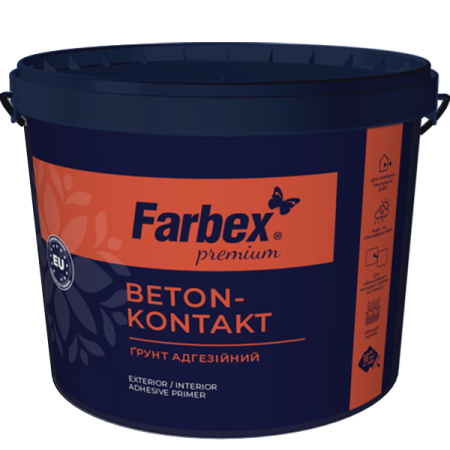
Specification
It has high adhesive property and gives the surface roughness. Treated surface is resistant to water, frost, precipitation and sunlight.
Sphere of application
It is intended for the initial treatment of various types of surfaces to increase their adhesion and simplify the application of gypsum, lime-gypsum, lime-cement, sand-cement and polymer plasters, paints, putties, and adhesives for tiles and other adhesives. For exterior and interior use. It is applied on any mineral surface, as well as on plywood, fiberboard, chipboard, OSB, ceramic tiles, glass, surfaces that are painted with alkyd and oil paints, surfaces with elements of PVC plastic, galvanized steel, undercoated iron. It can be used as a bonding layer for cladding using the tile-to-tile method.
Tinting
Tint it manually using pigment concentrate Farbex Color, other water-based tinting pastes or with a tinting machine according to color catalogs NCS and others.
We recommend tinting the primer in the same color (or as close to it as possible) as the finishing coating has.
After tinting, some insignificant deviations in technical data for the product are allowed.
Content
Technical data
| Consumption standard of 1 layer | 0,25-0,3 kg/m2 |
| Thinner | Water. Beton-kontakt is ready to use and does not require any dilution. |
| Application | With a brush, a roller or machine method. |
| Drying period (23 °С, 50% RH) | 3 hours. Drying period increases if the temperature is getting down and relative air humidity is increasing. |
| Solids content (DSTU ISO 3251) | 70±2 % |
| Density (DSTU ISO 2811-1) | ≈ 1,6 g/cm3 |
| Particle size | no more than 500 microns |
| Warranty period | 24 months |
| Packaging | 1,4 kg, 4,2 kg, 7 kg, 14 kg |
Application instruction
The condition for receiving a desired result is following directions for using the paint product and preparing the surface.
1. Surface preparation
The surface is prepared according to DSTU-N B A.3.1-23:2013 and DSTU-N B B.2.6-212:2016.
The surface must be dry – the humidity of the surface on all stages of preparation and paint works must be less than 5% for cement and cement-sand surfaces and less than 1% for gypsum ones.
The surface must be clean from chalk and lime whitewashings, grease and oily stains, and other contaminations, efflorescence, dust (including abrasive dust after polishing plasters and stuccos), old paint products and wallpapers (which stick to the surface not secure), polymer adhesives, and runs of construction mortars or composites.
Mineral surfaces must be hard, without fragile parts or edges. The base materials like plaster, stucco, insulating or adhesive elements must be completely dry and be ready for priming and coating with acrylic water-based products.
Parts of the surface infected with mould or fungi must be removed: first mechanically and then treated with antiseptic for mineral surfaces TM Farbex.
Remove contaminations, infections, old coatings, or fragile parts with a wire brush, a spatula, a scratcher or with a polisher.
Correct appeared defects with Plaster TM Farbex (depending on the character of the defects).
Clean metal surfaces manually with mechanical instruments (min degree St2) or abrasive jet cleaning (min degree Sa2½) according to DSTU ISO 8501-1. Degrease the surface with Univestal Thinner TM Maxima.
Existing metal elements in the base surface or those that will be used after painting must be made of galvanized or stainless steel. When you use iron elements, they must be initially protected against corrosion with special primers or other products.
Check the compatibility of the products on a small area following technical recommendations or specialists’ consultation before you use other products (an adhesive, an antiseptic, a plaster, etc.).
Follow the directions precisely (especially drying period and subsequent treatment) when further priming and painting construction mortars or products. For example, fresh cement plasters must not be treated for 28 days, fresh concrete - 3 months, the surfaces of insulating systems - 7 days.
Glass, ceramic tile and PVC plastic are recommended to be treated with abrasives manually (to make the surface rough and increase adhesion to it). Remove abrasive dust from the surface. Then degrease the surface with universal thinner TM Maxima.
2. Priming
Providing maximal exploitation resistance and a better decorative effect, depending on the type, prime the surface:
Timber porous surfaces - acrylic wood-protective primer TM Maxima.
Metal surfaces - quick-drying anticorrosion primer TM Maxima or anticorrosion primer GF-021 TM Farbex.
Mineral surfaces - deep-penetrating water-based primer TM Farbex.
Hard types of OSB, chipboards, fiberboards, wallpaper, and hard old paint coatings need no priming before coating.
Pay attention to the recommendations about the priming of construction mortars and materials. If necessary, call the specialists of POLYSAN.
3. Applying
Stir the product thoroughly before use. The product is ready to use and needs no dilution. Extremely porous, rough surfaces require more consumption of the product. The precise consumption is determined by a testing application on a small area. Carry out priming without pauses in one direction and with the same consumption of the product. The condition of good adhesion is homogeneous spreading of quartz filler on the surface.
When you work on large areas and/or during a long period, stir the product at time to time. We do not recommend keeping the container with the product open for a long time.
Carry out works at the temperature of the air and the surface from +5 ºС to +35 ºС and relative air humidity under 80% (the temperature of the surface must be 3 degrees above the dew point). Do not apply the product under direct sunlight, strong wind, and precipitations.
Remember! Mineral and wooden surfaces are porous materials, and the consumption of the product can be increased.
The coating must not be affected by precipitations and/or subzero temperatures before you apply a finish coating. All subsequent works must be carried out after 24 hours.
Adhesive primer Beton-kontakt can be applied with following methods:
|
Method of application |
Quantity of diluent |
A jet size |
Pressure |
|
Pneumatic spraying – with a hopper spray gun |
No diluting is recommended
|
2,0 – 2,5 mm |
0,3 – 0,5 MPa ( ≈ 3 - 5 bar) |
|
A brush / a roller |
- |
- |
To provide maximal exploitation resistance, we recommend Beton-kontakt be applied with a ceiling brush.
The tools must be recommended for solvent-based products.
When you apply with a roller, we recommend using a cuvette for homogeneous wetting of the tool.
When applying by spraying, follow the instructions for use.
For a quality coating, you must obtain painting and finishing skills, especially if you use professional instruments.
During outdoor (façade) works, we recommend carrying out works under “tent cover for facades and construction scaffolds”.
Before using adhesion primer on specific base surfaces (glass, plastic, ceramic tiles, stainless steel, or undercoated metal and others) must be test primed on a small area of the surface and after drying in 1-2 days check the quality of adhesion of the primer to the base surface.
Compatibility with other coatings
Depending on the exploitation conditions, it can be used with different primers and finishing coatings. The examples are stated further. Call the specialists of POLYSAN to receive more detailed recommendations.
Previous coating –acrylic water-based products or alkyd-based products. A subsequent coat is acrylic, silicone, water-based products, and mineral plasters, stuccos, and adhesives.
Compatibility of the products (including adhesion between the products) is recommended to be tested on a small area of the surface. Attention! The primer creates a rough surface, thus it is impossible to receive a smooth surface if you finish it with enamels or paints.
4. Tool cleaning
When the work is finished, rinse thoroghly the tools with water.
Flow calculator
Consumption standard of 1 layer
When calculating the area to be painted, you need to subtract the area that will not be painted. (windows, doors, etc.)
Paint consumption may vary depending on dilution and uniformity of application of the paint.