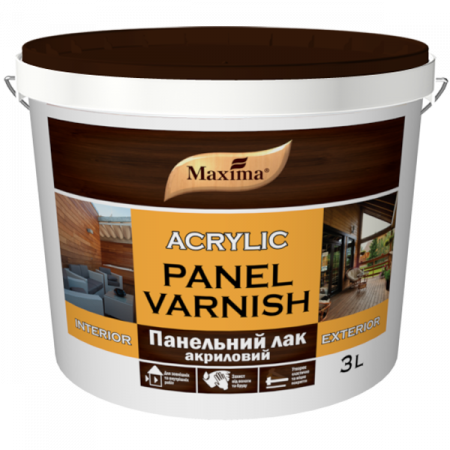
Maxima
Panel Varnish аcrylic
Specification
- It is intended for indoor and outdoor works.
- It creates solid and elastic film, which does not grow yellow and does not decrepitate with time.
- It does not change the colour of the wood and emphasizes its natural beaty.
- It is resistant to washing with cleaning agents.
- It has high adhesion to the basis.
- It dries quickly.
Sphere of application
Acrylic panel varnish is intended for decorative and protective treatment of linings, scrub-boards, window frames, panels of natural wood, plywood, chip board, MDF, mineral surfaces (bricks, decorative stone, concrete, plaster, putty). Do not use for lacquering of floor and furniture!
Content
Technical data
| Consumption standard of 1 layer | 80-100 g/m2, depending on the kind of wood and quality of timber as well as way of application. |
| Thinner | Water. Delution of the product is possible but maximum 10% of the total weight. |
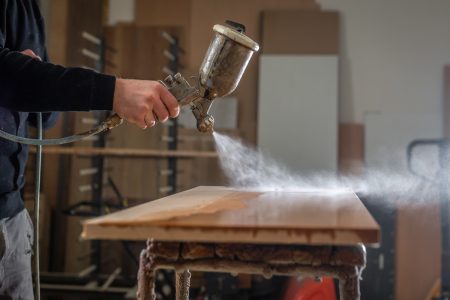
| Application | It is applied with a roller, a brush or a spraying gun. |
| Drying period (23 °С, 50% RH) | < 2 hour. Drying period increases if the temperature is getting down and relative air humidity is increasing. |
| Gloss (DSTU ISO 2813) | Glossy. Minimal 60 GU at 60° Silky-matt. Maximal 20 GU at 60° |
| Hardness (DSTU ISO 1522) | > 25 sec, Konig pendulum |
| Solids content (DSTU ISO 3251) | 30±2 % |
| Density (DSTU ISO 2811-1) | 1,02 - 1,05 g/сm3, depending on the gloss degree. |
| Warranty period | 36 months from the date of manufacturing (at the temperature from +5 °С till +35 °С) |
| Packaging | 0,9 kg, 3 kg, 5 kg, 10 kg |
Gloss
Color
Application instruction
The condition of receiving a desired result is following directions for using the paint product and the preparation of the surface.
1. Surface preparation
The surface shall be dry and thoroughly cleaned to the hard base surface from dust, dirt, mould, corrosion, polishing products, oils, or other contaminations, and peeling paint coatings. Use these methods of cleaning: mechanical (a scratcher or wire brush), thermal (a heat gun or infrared radiation), and chemical (paint-removal solutions). Avoid using a cleaning option that can damage the base surface.
Wood humidity must be less than 20% before varnishing.
If there are resin deposits on the surface, remove them mechanically (with a spatula or a scratcher).
To make the surface more attractive, emphasize the pattern of the wooden layers, improve the coating properties, prolong the life of the finishing paint product, we recommend polishing the timber along the fibers. Remove the dust after polishing.
If the wood is infected with a blue stain, mould, or fungi, the infected area must be removed: first, mechanically, and then treated with Antiseptic for wooden surfaces TM Farbex.
Created uneven areas and existing surface defects (holes, shallows, and scolds) must be corrected with a Stucco TM Farbex. After correction, polish the surface and dust it off.
Previously coated hard surfaces must be polished and dusted off. It helps improve the adhesion of the paint product.
The best decorative effect is achieved if the coated surface is fully cleaned of old coatings.
Mineral-based surfaces must be hard, without fragile parts or edges. All surface elements must be fully dry and suitable for coating with water-based products. Clean all contaminations thoroughly: efflorescence must be removed mechanically; areas infected by mould and fungi must be removed: first, mechanically, and then treat the surface with Antiseptic for Mineral surfaces TM Farbex. Created uneven areas must be corrected with Plaster TM Farbex. After correction polish the surface and dust it off.
Before you use subordinate products (primer, adhesive, antiseptic, etc.), we recommend checking compatibility on a small area of the surface, following all recommendations and hints made by specialists.
2. Priming
To provide a maximal resistance life of the coating, we recommend using these products for new and completely cleaned surfaces:
Acrylic wood-protective primer TM Maxima for wooden surfaces. ATTENTION! The primer pushes up wood fibers, therefore we recommend polishing the surface and after that applying the varnish.
Primer-concentrate 1:10 TM Maxima. Depending on the type of surface, dilute the primer if necessary and according to the directions.
Hard types: OSB, wood chip boards, fiberboards, wallpapers, and hard old paint coatings need no initial priming before coating.
It is necessary to take into account the recommendations regarding the priming of constructive mortars or products. If necessary, consult the specialists of POLYSAN.
3. Applying of finishing layer
Make sure all previous layers of coating are dry. Stir the product thoroughly until homogeneous before use. If necessary, filter the varnish, dilute it with water till working viscosity (abnormal diluting can spoil the product traits).
Apply varnish in 2 coats with intermediate polishing. Apply a subsequent coat after 3 hours. The coating fully dries and attains its properties after 14 days. When you apply the finishing coat, we recommend using the product of a single batch. In case you use the product from different batches, we recommend mixing it.
Carry out work at the temperature of the air and the working surface from +10 ºС till +30 ºС and relative air humidity less than 80 %. During the varnish application and drying, it is necessary to provide an appropriate ventilation.
REMEMBER! Wooden and mineral surfaces are porous materials, therefore the consumption of varnish and the quantity of coats can increase.
We recommend polishing with a continuous layer along wood fibers, or "from edge to edge (from corner to corner)" or within the limits of decorative elements without breaks.
Thorough treatment of the edges of the wood substantially increases its life.
When you apply the varnish on a large area and/or for a long period, stir the varnish from time to time. We do not recommend keeping the container open for a long period.
Do not apply the varnish under direct sunlight, strong wind, frost and precipitation. The coating must not be affected by precipitation or subzero temperatures for 24 hours.
Acrylic panel varnish can be applied in these ways:
|
Way of application |
The quantity of diluent |
Jet size |
Pressure |
|
Airless spraying |
0 – 5 % |
0.011" - 0.013" |
5 MPа ( ≈ 150 bar) |
|
Pneumatic spraying |
0 – 10 % |
1.5 – 2,0 мм |
0,3 – 0,5 MPа ( ≈ 3-5 bar) |
|
A brush / a roller |
0 – 5 % |
- |
- |
Tools must be recommended for water-based products.
If you apply with a roller, we recommend using a cuvette for homogeneous wetting of the tool. Attention! For a smoother coating, we recommend using the rollers with a shorter nap.
When you use instruments for the spraying application method, you should follow instruction for exploitation.
For a quality coating, you have to achieve painting skills, especially if you use professional instruments.
Compatibility with other coatings
Depending on the terms of exploitation, the paint can be used with different primers and finishing coatings. The examples of compatibility are dwelt on below. If you need more precise recommendations, ask the specialists of POLYSAN.
Previous coat – alkyd-based products and acrylic water-based products.
Subsequent coat – acrylic water-based products.
We recommend testing product compatibility on a small area of the surface.
4. Tool cleaning
Clean tools with water after application. Do not let them dry. Dry product shall be removed from the tools in mechanical way.
References
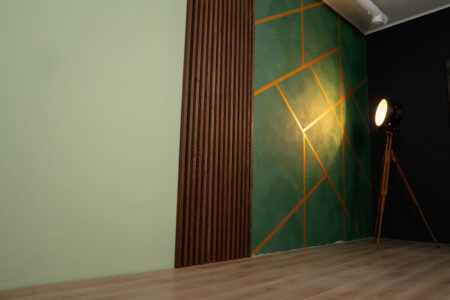
The walls of the studio are painted with Silk Touch 3 Maxima matte latex paint. …

Зовнішні роботи: фасад будівлі пофарбований гумовою фарбою Farbex (колір RAL 1015) Внутрішні роботи: стіни пофарбовані …
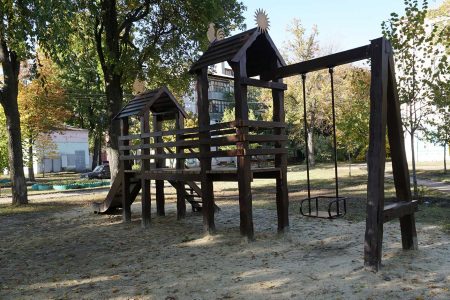
Дерев’яні конструкції пофарбовані гумовою фарбою Farbex та панельним лаком Maxima.
Tips
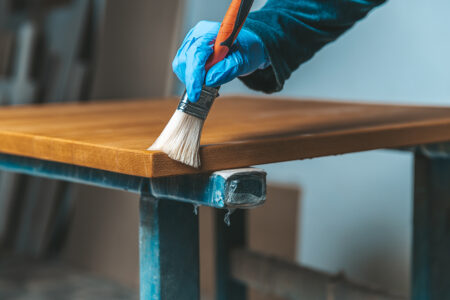
Як вибрати лак для дерева для внутрішніх і зовнішніх робіт: види лаків
Лак для дерева – це одночасно захист деревини і збереження її природної краси. Дерево вразливий матеріал. Шкідники, дія вологи, перепади температур – все це несе негативний вплив і без захисного покриття деревина швидко втрачає естетичну привабливість і цілісність основи. Хоча …
Які бувають лаки для дерева
Дерево – це той будівельний матеріал, застосування якого можна побачити практично на кожному кроці. Із дерева будують домівки, паркани, роблять меблі та використовують для оздоблення та декору інтер’єра. Завдяки своїй природній красі, унікальній структурі дерево дуже красивий та екологічний матеріал. …
Flow calculator
Consumption standard of 1 layer
When calculating the area to be painted, you need to subtract the area that will not be painted. (windows, doors, etc.)
Paint consumption may vary depending on dilution and uniformity of application of the paint.