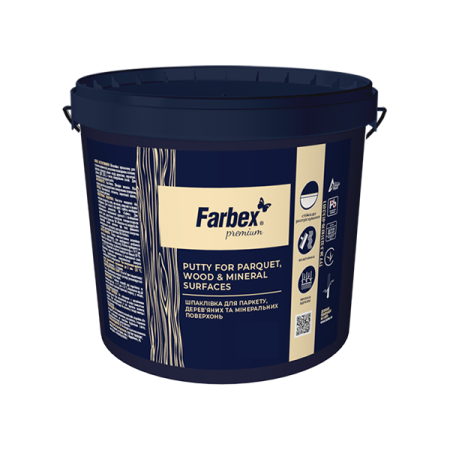
Farbex
Putty for parquet, wooden and mineral surfaces
Specification
It is elastic. It dries quickly. It has high adhesion to wooden and mineral surfaces.
Sphere of application
The putty is intended to correct defects and minor damage on the surfaces of various types of wood, parquet boards, woodchip boards, MDF, and mineral surfaces. It suits interior and exterior works.
Tinting
It is tinted manually with pigment concentrate Farbex Color, other water-based pastes, or in tinting machines according to NCS color rate and others. When tinting with other products, tinting machines, or according to catalogs, you must consider their suitability for exterior works and make a trial tinting and application with finishing coating.
To avoid differences in color shades, we recommend using the products of the same batch (as for the plaster, so for the colorant). Use the product of the same batch for joint surfaces. If you use the products of different batches, you must mix them.
Check the correspondence of the chosen color by a trial application on a small area of the surface together with finishing products.
We do not recommend diluting the stucco when applying.
Minor deviations in technical data are possible after tinting.
A hint: when you coat a tinted stucco with transparent finishing products, the color of the stucco can be more intense or darker; therefore, it is necessary to make a trial application of all products on a small area of the surface.
Content
Technical data
| Consumption standard of 1 layer | 1,8 kg/m2 with a layer sickness of 1 mm |
| Thinner | Water. A maximum dilution of 5% of the total weight is allowed. |
| Application | Apply with a stainless spatula. |
| Drying period (23 °С, 50% RH) | 2 hours if the coat is 1 mm thick. Drying period is increased if the temperature falls, relative air humidity rises, and depends on the consumption (the coat thickness) of the product. |
| Solids content (DSTU ISO 3251) |
73±2 % |
| Density (DSTU ISO 2811-1) | 1.79 – 1.81 g/cm3, depending on the color |
| Particle size | Max. 100 µm, (fine-grained, S1, DSTU EN 1062-1) |
| Resistance to washing | Cat. С, from 50 to 150 µm, DSTU EN 16566 |
| Gloss (DSTU ISO 2813) | Less than 5, Class G3, matt |
| Water permeability (DSTU EN 1062-3) | not more than 2,5 kg/(m2*ч0,5), class W1, high |
| Vapor permeability (EN ISO 7783-2) | non less 500 g/(m2*24 hours), class V1, high |
| Marking acc. to the DSTU EN 16566 | G3|S1|V1|W1|A0|C0|RC |
| Non-volatile matter by volume (DSTU ISO 3233) |
51,5±2 % |
| Warranty period | 18 months |
| Packaging | 0,35 kg, 0,7 kg, 1,5 kg |
Color






Application instruction
The condition for receiving a desired result is following directions for using the paint product and preparing the surface.
1. Surface preparation
The surface must be dry, thoroughly cleaned to a hard base surface from dust, dirt, mould, corrosion, polishing products, oily or other contaminations, and peeling paint coatings. Use mechanical (a scratcher, a wire brush), thermal (a heat gun, infrared radiation) or chemical (paint-removing products) methods. You must avoid using methods of cleaning which can damage the base surface.
In case there is resin on the surface of wood, you must remove it mechanically (a spatula or a scratcher). Then rub the places where was contact with the resin, oily stains, rests of cleaning products with Universal thinner TM Maxima.
In case the wood is infected with blue stain, mould or fungi, you must remove them mechanically and then treat the wood with antiseptics for wooden surfaces TM Farbex.
Wood humidity before coating must be less than 20%.
Preparation of mineral base surfaces is carried out according to DSTU-N B A.3.1–23:2013 and DSTU-N B V. 2.6–212:2016.
Mineral surfaces must be hard, without fragile parts or edges. Plastered or adhesive elements must fully dry and be ready for treating with water-based products.
The surface must be dry – the humidity of the mineral base surface before undercoating must be less than 5% for cement and cement-sand base surfaces; but less than 1% for gypsum ones.
You must thoroughly remove all contamination: efflorescence must be removed mechanically; surfaces infected with mould or fungi must be cleaned mechanically and then treated with antiseptics for mineral surfaces TM Farbex.
If you use foreign products (an adhesive, antiseptics, etc.), we recommend checking their compatibility on a small area of the surface following technical recommendations or specialists’ consultations.
2. Priming
Wooden surfaces need no wood-protective primer before applying the plaster. We recommend undercoating the surface, along with the plaster, after it has dried and been polished.
Crumbling, porous mineral base surfaces with high absorption capacity (gypsum or cement plasters/stuccos) must be treated with deep-penetrating primer TM Farbex.
Hard base surfaces (concrete, gypsum boards, etc.) need no deep-penetrating primer. The surfaces are recommended to be undercoated together with the plaster after it has dried and been polished.
3. Applying
Before plastering, make sure that the surface is dry enough after preparation.
Stir the product carefully before use; if necessary, dilute with water. Abnormal dilution spoils the quality of the coating!
The thickness of one coat must not exceed 2 mm. In case of broader hollows or bigger defects, apply the subsequent coat after the previous one is dry.
When you work on large areas and/or during a long period, you must stir the plaster from time to time. We do not recommend keeping the container open for a long period.
Carry out plastering at the temperature of air and the surface from + 10 °С till + 35 °С and relative air humidity less than 80%. Do not use the plaster under direct sunlight, strong wind, frost, and precipitation. After application, the plastered surfaces must not be affected by precipitation or subzero temperatures before you apply a finishing coating.
Apply the plaster with a stainless steel spatula (the tool must be recommended for water-based products).
You must obtain finishing skills or carpenter’s skills to achieve a quality result.
Polish the surface and undercoat it before applying finishing coatings (paint, enamel, etc.). For wooden surfaces, you must use wood-protective primer TM Maxima, which can be alkyd-based or water-based depending on the type of finishing paint product.
Use water-based primer TM Farbex for mineral surfaces according to the directions for application.
We do not recommend using the product as a filler for seams between parquet panels.
If you coat a colored product with a transparent finisher, the color of the plaster can become more saturated or darker; therefore, you must carry out a trial application of all products on a small area of the surface.
All subsequent works must be carried out no earlier than 24 hours after you applied the last coating of the plaster.
Compatibility with other coatings
Depending on the operating conditions, the putty can be used with different finishing coatings. Examples of compatibility are given below. For more detailed recommendations, contact the specialists of the POLISAN company.
Previous layer - application to a cleaned, prepared surface is recommended.
The next layer - solvent-based alkyd materials or acrylic water-dispersion materials.
It is recommended to test the compatibility of materials on a small area of the surface.
4. Tool cleaning
Clean tools with water after application. Do not let them dry.
Tips
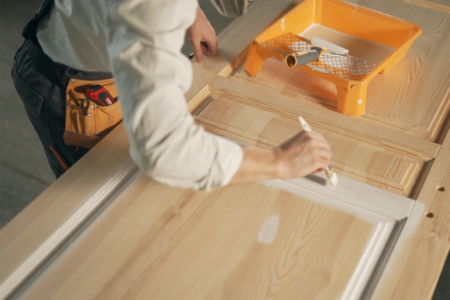
What Coating is Suitable for Interior Wooden Doors and MDF
Wooden interior doors have always been and remain popular due to the natural beauty of timber and the exploitative traits of this material. It has good sound and heat insulation. Wood is reliable, practical and durable. However, due to the …
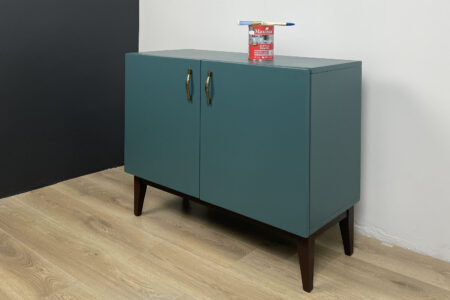
Реставрація старих меблів
Реставрація старих меблів — це не лише спосіб заощадити, а й можливість вдихнути нове життя у речі з історією. На прикладі старої полакованої тумби покажемо, як за допомогою сучасних лакофарбових матеріалів можна досягти якісного та довговічного результату. З часом лакове …
Flow calculator
Consumption standard of 1 layer
When calculating the area to be painted, you need to subtract the area that will not be painted. (windows, doors, etc.)
Paint consumption may vary depending on dilution and uniformity of application of the paint.