
Delfi
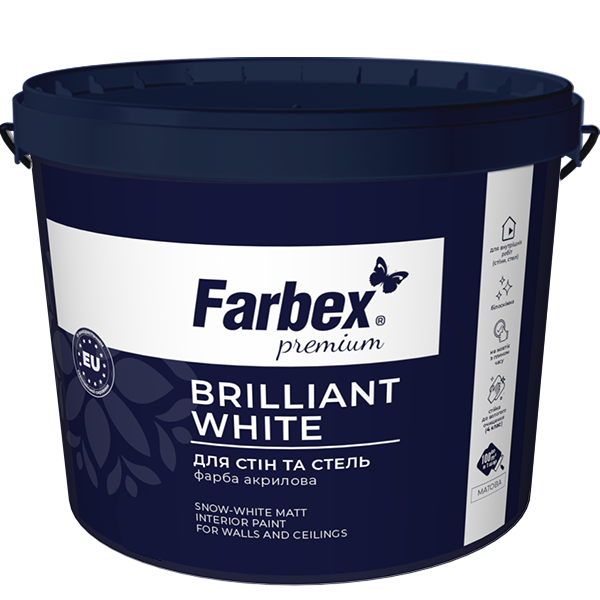
Profi White
Acrylic latex paint for walls and ceilings
Specification
Snow-white paint. Due to its high degree of whiteness, it visually lightens the space. It doesn't get yellow with time. It creates a matt coating, which is resistant to dry cleaning and lets the walls "breathe".
Sphere of application
It is intended for interior coating of all mineral (stucco, plaster, brick, concrete), gypsum, and wooden surfaces, wallpaper, and fiberglass. It is recommended for initial and renovating coating of walls and ceilings in dry spaces with low exploitation loading: living, administrative premises, medical, infant, and educational establishments, premises of catering and industrial enterprises.
Tinting
It is intended as a single white coating or for tinting in pastel colors.
Tint it manually with pigment concentrate Farbex Color (max. 1% or 1 bottle for 10 L of paint), other waterborne tinting pastes (up to 1% of the total weight of the paint), or with a tinting machine according to NCS color rate and others.
If you tint with other products, machines, or catalogs, a test tinting and coating must be done.
To avoid deviation in color shade, we recommend using the product of the same batch (as for paint, so for colorant) for the finishing coat. Use the product of the same batch for one color if you coat surfaces. If you use products from different batches, you must mix them.
We do not recommend diluting the paint for the finishing coat. After tinting, some minor deviations in technical data for the product are allowed.
A hint: When you choose a color, take into account the lighting in the premises. Warm or cold light provides a different color perception of the same color.
Content
Technical data
| Consumption standard of 1 layer | 140-180 g/м2 . Depending on the way of application and type of surface. |
| Thinner | Water. It is allowed to dilute max. 10% of the total weight of the product. |
| Application | Apply with a roller, a brush or a spraying gun. |
| Drying period (23 °С, 50% RH) | 1 hour. Drying period increases if the temperature falls, relative air humidity raises and depends on the consumption rate of the paint (coating thickness). |
| Solids content (DSTU ISO 3251) |
56±2 % |
| Density (DSTU ISO 2811-1) | ≈ 1,48 g/cm3 |
| Gloss (DSTU ISO 2813) | Max. 10 GU at 85°, (matt, TSS U EN 13300) |
| The degree of milling (SSU ISO 1524) | Max. 15 micron , (fine-grained, TSS U EN 13300) |
| Contrast ratio of dry film (ISO 6504-3) | 97,5 - 98,5 %, 3 class of hiding power (acc. to DSTU EN 13300) |
| Wet-scrub resistance class (DSTU EN 13300) | 5 |
| Warranty period | 24 months from the date of manufacturing (at the temperature from +5 °С till +35 °С) |
| Packaging | 1,4 kg, 4,2 kg, 7 kg, 14 kg |
Gloss
Color
Application instruction
The condition for receiving a desired result is following directions for using the paint product and preparing the surface.
1. Surface preparation
The surface is prepared according to DSTU-N B A.3.1-23:2013 and DSTU-N B B.2.6-212:2016.
The surface must be dry – the humidity of the surface on all stages of preparation and paint works must be less than 5% for cement and cement-sand surfaces and less than 1% for gypsum ones.
The surface must be clean from chalk and lime whitewashings, grease and oily stains, and other contaminations, efflorescence, dust (including abrasive dust after polishing plasters and stuccos), old paint products and wallpapers (which stick to the surface not secure), polymer adhesives, and runs of construction mortars or composites.
Mineral surfaces must be hard, without fragile parts or edges. The base materials like plaster, stucco, insulating or adhesive elements must be completely dry and be ready for priming and coating with acrylic water-based products.
Parts of the surface infected with mould or fungi must be removed: first mechanically and then treated with antiseptic for mineral surfaces TM Farbex.
Remove contaminations, infections, old coatings, or fragile parts with a wire brush, a spatula, a scratcher or with a polisher.
Correct appeared defects with Plaster TM Farbex (depending on the character of the defects).
Existing metal elements in the base surface or those that will be used after painting must be made of galvanized or stainless steel. When you use iron elements, they must be initially protected against corrosion with special primers or other products.
Check the compatibility of the products on a small area following technical recommendations or specialists’ consultation before you use other products (an adhesive, an antiseptic, a plaster, etc.).
Follow the directions precisely (especially drying period and subsequent treatment) when further priming and painting construction mortars or products. For example, fresh cement plasters must not be treated for 28 days.
2. Priming
To provide maximum resistance to exploitation and a better decorative effect, depending on the type, the surface must be undercoated:
Wooden porous surfaces with acrylic wood-protective primer TM Maxima. Attention! The primer raises up fibers of wood, that is why it is necessary to polish the surface before applying the paint.
Mineral surfaces with acrylic deep-penetrating primer concentrate TM Delfi. Dilute the primer depending on the type of the surface and according to the use manual for the primer (see the manual for the primer use).
Hard types of OSB, woodchip panels, MDF, wallpapers, and hard paint coatings do not require priming before coating. You must consider recommendations for priming construction mortars or materials. If necessary, call the specialists at POLYSAN.
3. Applying of finishing layer
Stir the paint thoroughly before application. If it is required dilute it with water. Over-dilution makes the quality of the surface worse! Application is performed at the temperature from + 5 °С till + 35 °С and relative air humidity no more than 80%. Apply the paint in 1-2 coats with a brush, a roller, or a spraying gun.
4. Tool cleaning
Clean tools with water after application. Do not let them dry. Dry product shall be removed from the tools in mechanical way.
You may also be interested in


Flow calculator
Consumption standard of 1 layer
When calculating the area to be painted, you need to subtract the area that will not be painted. (windows, doors, etc.)
Paint consumption may vary depending on dilution and uniformity of application of the paint.