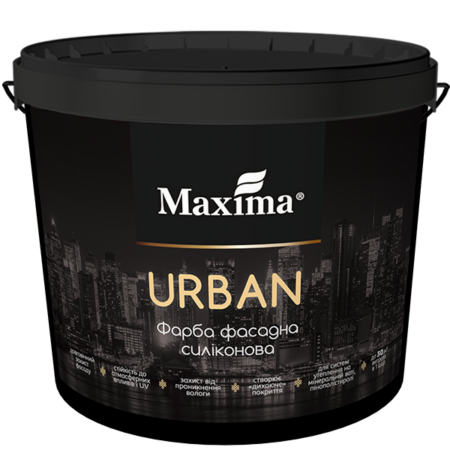
Maxima
Facade silicone paint “Urban”
Specification
Matt. It provides a hard coating that is resistant to weathering, moisture, UV radiation, and temperature fluctuations. The paint obtains the effect of "self-cleaning" - during precipitation (rain), contaminations are removed from the surface. It reliably protects against moisture penetration; meanwhile, vapor permeates it without obstacles (it has high vapor permeability and low water absorption according to DSTU EN 1062). It is elastic and has good adhesion to surfaces. It is easy to apply, doesn't create runs, and doesn't splash during application. It is tinted manually or in tinting machines according to the color ratio nCS and others.
Sphere of application
It is intended for coating mineral surfaces (concrete, foam concrete, brick, cement, and lime-cement mortars, gypsum plaster, plasters based on acrylic and silicone resins), gypsum boards, wood-based surfaces (plywood, wood-chip boards, fiberboards, OSB), and facades (including cases with mineral cloth). It is intended for the initial and renovating coating of facades of public and living buildings (industrial, storage, trade, and other buildings, including buildings of historical value and monolite-framed constructions). For exterior works.
Tinting
The product is manufactured in following bases:
Base A. It is intended for use as a white finishing coating or for tinting in pastel, light colors. Base TR. It is intended for tinting in saturated colors. Base TR cannot be used without tinting.
It is tinted manually using pigment concentrate Farbex Color, other water-based tinting pastes, or with tinting machines according to the color catalog NCS and others. If you tint with other products, tinting machines, or catalogs, you must take into account their suitability for exterior works, silicone products, and carry out test tinting and application.
We recommend using the product of the same batch (the paint and the colorant) for coating the surfaces to avoid differences in color shades. Use the product of the same batch for the surfaces that join each other. In case you use the product of different batches, it is necessary to mix them.
Carry out a test application on a small area to check that the color corresponds to the chosen one.
We do not recommend diluting the product for a finish coating.
After tinting, insignificant deviations of product technical data are possible.
A hint: When you choose a color, take into account the lighting and the location of façade elements according to the sun, and their structure. Elements in shadow, bowed surfaces, elements with different roughness, day light duration will provide different eye-perception of the same color.
Content
Technical data
| Consumption standard of 1 layer | 120 - 150 g/m2, depending on the way of application and the type of the surface. |
| Thinner | Water. Dilution of maximal 10% of the total weight of the product is allowed. |
| Application | Apply with a roller, a brush or a spraying gun. |
| Drying period (23 °С, 50% RH) | 2 hours |
| Color base | А, TR. It is shaded according to NCS color range. |
| Solids content (DSTU ISO 3251) | 55±2 % (base А, base TR) |
| Density (DSTU ISO 2811-1) | ≈ 1,44 g/sm3(base А), ≈ 1,36 g/cm3 (base TR) |
| Gloss (DSTU ISO 2813) | < 5 GU (matt, max. 10 GU at 85°, G3, DSTU EN 1062-1) |
| Dry film thickness | 50-100 microns, for a single layer (E2, DSTU EN 1062-1) |
| Particle size | max. 30 microns , (fine-grained, S1,DSTU EN 1062-1) |
| Vapor permeability (EN ISO 7783-2) | > 150 g/(m2*day) , (high, V1, DSTU EN 1062-1) |
| Water permeability (DSTU EN 1062-3) | max. 0,1 kg/(m2* h0,5) , (low, W3, DSTU EN 1062-1) |
| Marking acc. to the DSTU EN 1062-1 | G3|E2|S1|V1|W3|A0|C0 |
| Warranty period | 24 months from the matufacturing date (at the temperature from +5 °С till +35 °С) |
| Packaging | Base А - 1,4 kg, 4,2 kg, 7 kg, 14 kg Base В, TR - 1,2 kg, 3,6 kg, 6 kg, 12 kg |
- . Drying period increased if the temperature falls and relative air humidity increases. It depends on consumption (the thickness of the coat) of paint. The drying period increases
Gloss
Color
Application instruction
The condition of receiving a desired result is following directions for using the paint product and the preparation of the surface.
1. Surface preparation
The surface is prepared according to DSTU-N B A.3.1-23:2013 and DSTU-N B B.2.6-212:2016.
The surface must be dry – the humidity of the surface on all stages of preparation and paint works must be less than 5% for cement and cement-sand surfaces and less than 1% for gypsum ones.
The surface must be clean from chalk and lime whitewashings, grease and oily stains, and other contaminations, efflorescence, dust (including abrasive dust after polishing plasters and stuccos), old paint products and wallpapers (which stick to the surface not secure), polymer adhesives, and runs of construction mortars or composites.
Mineral surfaces must be hard, without fragile parts or edges. The base materials like plaster, stucco, insulating, or adhesive elements must be completely dry and be ready for priming and coating with acrylic water-based products. Parts of the surface infected with mould or fungi must be removed: first mechanically and then treated with antiseptic for mineral surfaces TM Farbex. Remove contaminations, infections, old coatings, or fragile parts with a wire brush, a spatula, a scratcher or with a polisher.
Correct appeared defects with Plater TM Farbex (depending on the character of the defects).
Existing metal elements in the base surface or those that will be used after painting must be made of galvanized or stainless steel. When you use iron elements, they must be initially protected against corrosion with special primers or other products.
Check the compatibility of the products on a small area following technical recommendations or specialists’ consultation before you use other products (an adhesive, an antiseptic, a plaster, etc.). Follow the directions precisely (especially drying period and subsequent treatment) when further priming and painting construction mortars or products. For example, fresh cement plasters must not be treated for 28 days, fresh concrete - 3 months, the surfaces of insulating systems - 7 days.
2. Priming
To provide maximum exploitative resistance and a better decorative effect, depending on the type, the surface must be primed:
Wooden porous surfaces with acrylic wood-protective primer TM Maxima.
Mineral surfaces with silicone deep-penetrating primer TM Farbex.
Dense types: OSB, woodchip boards, fiberboards, wallpaper. Old hard paint coatings demand no priming before coating.
Follow the directions for priming construction mortars or products. If necessary, call the specialists of POLYSAN.
3. Applying of finishing layer
Before applying the paint, make sure that the surface is dry enough after preparation.
Stir the paint thoroughly before use. Filter it and dilute with water if necessary. Abnormal dilution spoils the quality of the coating!
Apply the paint in 2 coats. Apply a subsequent coat in 2 hours. On extra porous, rough, or very contrasted surfaces, the quantity of coats and consumption of paint can increase. The precise consumption can be determined by a test coating on a small area.
The coating must be continuous and in one direction with the same consumption of the product. We recommend applying “from edge to edge” (from corner to corner) or within the limits of decorative elements without breaks. Applying the paint on a large area and/or during a long period, do not keep the container with the paint open.
Carry out painting at the temperature of the air and the surface from + 5 °С to + 30 °С and relative air humidity less than 80%. Do not apply paint under direct sunlight, strong wind, frost and precipitation. The coating shall not be affected by precipitations during 12 hours after application.
Mechanical loading resistance appears after 24 hours. The coating achieves complete hardness and resistance to mechanical loading after 28 days.
Silicone facade paint URBAN can be applied in these ways:
|
Way of application |
The quantity of diluent |
Jet size |
Pressure |
|
Airless spraying |
0 – 10 % |
0.019" - 0.023" |
15 - 18 MPа ( ≈ 150 - 180 bar) |
|
Pneumatic spraying |
0 – 10 % |
2,0 – 2,5 мм |
0,4 – 0,5 MPа ( ≈ 4-5 bar) |
|
A brush / a roller |
0 – 5 % |
- |
- |
Tools must be recommended for water-based products.
If you apply with a roller, we recommend using a cuvette for homogeneous wetting of the tool. Attention! For a smoother coating, we recommend using the rollers with a shorter nap.
When you use instruments for the spraying application method, you should follow instruction for exploitation. We recommend using airless spraying for this method. The pneumatic spraying demands diluting the paint with water, and its quantity is often at the maximum recommended level, so it can couse lessening of the thickness of the coating or the creation of runs.
For a quality coating, you have to achieve painting skills, especially if you use professional instruments.
Carrying out exterior (façade) works, we recommend doing it under “the tent for facades and construction platforms (scaffolding)”.
Compatibility with other coatings
Depending on the terms of exploitation, the paint can be used with different primers and finishing coatings. The examples of compatibility are dwelt on below. If you need more precise recommendations, ask the specialists of POLYSAN.
Previous coat – acrylic or silicon water-based products.
Subsequent coat – silicon water-based products.
We recommend testing product compatibility on a small area of the surface.
4. Tool cleaning
After finishing the work, rinse the tools with water. Don't let them get dry. Marks of dry paint can be removed mechanically.
You may also be interested in
References
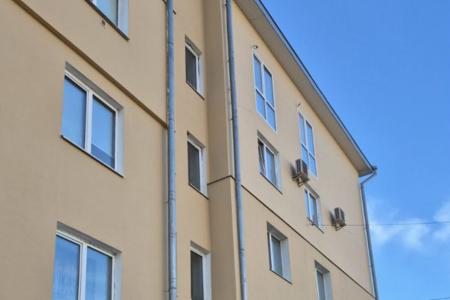
The facade of the house is painted with Maxima "Urban" facade silicone paint.
Silicone facade paints Maxima
Силіконова фарба - це сучасний надійний продукт. Вона виконує захисно-покривну функцію житлових, промислових, торгових та інших будівель. Саме ця фасадна фарба ідеально підходить для фарбування ззовні, оскільки, має здатність самоочищатися під час дощу. Краплі не вбираються в стіну, а вільно стікають. Силіконова фасадна фарба створює пористе покриття, яке не пропускає вологу всередину, але випускає пар назовні. Фасадна силіконова фарба має такі переваги:- висока паропроникність;
- низька водопроникність;
- висока міцність;
- атмосферостійка (ультрафіолетове випромінювання, перепади температури та інші);
- гарна адгезія;
- довговічне покриття.
повністю
Flow calculator
Consumption standard of 1 layer
When calculating the area to be painted, you need to subtract the area that will not be painted. (windows, doors, etc.)
Paint consumption may vary depending on dilution and uniformity of application of the paint.