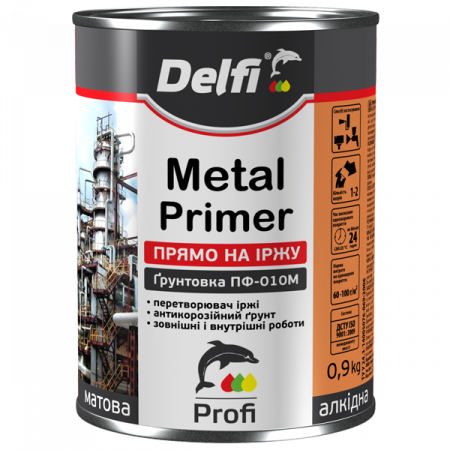
Delfi
Anticorrosion primer PP-010 M
Specification
It contains a corrosion inhibitor, which prevents corrosion progress. It has good adhesive properties to the base surface and to the coats, which will be applied over the primer. It significantly lessens enamel consumption and prolongs the period of paint coating life. It can be applied directly on corrosion if the layer of corrosion doesn't increase 100 microns.
Sphere of application
It is intended for protection against corrosion of all kinds of metal surfaces (constructional metal structures, tubes, outer surfaces of water tanks, garages, details of vehicles and apparatuses, farming machinery, racks, gates, etc.), and also wooden surfaces for further application of alkyd and oily paints. It is intended for the surfaces indoors and outdoors.
Content
Technical data
| Consumption standard of 1 layer | 60-100 g/m2, depending on the method of application and type of surface. |
| Solvent | thinner TM DekART or odorless thinner ТМ Maxima, up to 10% of the total primer weight. |
| Application | Apply with a brush, a roller or a spraying gun. |
| Drying period (23 °С, 50% RH) | max 8 hours. Drying period increases if the temperature is getting down and relative air humidity is getting higher. |
| Solids content (DSTU ISO 3251) |
> 60 % |
| Density (DSTU ISO 2811-1) | 1,48 ±0,05 g/sm3 |
| Hardness (DSTU ISO 1522) | more than 30 sec, Konig pendulum |
| Non-volatile matter by volume (DSTU ISO 3233) |
> 50 % |
| Warranty period | 12 months from the date of manufacturing. |
| Packaging | 0,9 kg, 2,8 kg |
Gloss
Color



Application instruction
The condition for receiving a desired result is following directions for using the paint product and preparing the surface.
1. Surface preparation
The treated surface must be dry and thoroughly cleaned of dust, dirt, and grease. Old coatings existing on the surface and loose layers must be removed to the hard base surface mechanically (a scratcher, a wire brush), thermally (a hot air blower, infrared radiation), or chemically (paint removal solutions).
Polish wooden surfaces manually or with mechanical equipment. Remove abrasive dust after polishing. If there are resin deposits on the surface of the wood, they must be removed mechanically (with a spatula or a scratcher). If wood is infected with blue stain, mould or fungi, you must remove infected parts mechanically and then treat the wood with antiseptics for wood TM Farbex. Equalize surface defects with plaster TM Farbex. Polish and dust off the plastered surface. Wood humidity before priming must be less than 20%. To improve the general properties of the coating, we recommend treating the wood with alkyd wood protective primer TM Delfi and TM Maxima before applying primer GP-021.
Treat metal surfaces manually with mechanical equipment (minimum St2 level), or with abrasive jet cleaning (minimum Sa2½) according to DSTU ISO 8501-1. Degrease the surface with thinner TM DekArt or odorless thinner TM Maxima.
2. Applying
Before you use a primer, stir the product to a homogeneous condition. Filter the product if necessary and dilute with thinner TM DekArt or odorless thinner TM Maxima to working viscosity (abnormal dilution spoils the product's resistance to runs and slows hardening). To provide optimal properties, prime the surface in 2 coats. Apply a subsequent coat no earlier than 24 hours. Carry out work at an air and surface temperature from +10 ºС to +35 ºС and relative air humidity less than 80% (the temperature must be 3 degrees higher than dew point). Provide appropriate ventilation during application and drying. Remember! Wooden surfaces are porous; therefore, consumption and the number of coats may increase. When you work with large areas and/or for a long period, you must stir the primer from time to time. We do not recommend keeping containers open for a long period. Do not apply the primer under direct sunlight, strong wind, or precipitation. The coating must not be affected by precipitation after the coating has been applied before you apply a finishing product.
Anticorrosion primer PF-010M can be applied by following methods:
|
Method of application |
Quantity of thinner |
Jet size |
Pressure |
|
Airless spraying |
0 – 10 % |
0.015" - 0.017" |
15 MPa ( ≈ 150 bar) |
|
Pneumatic spraying |
0 – 10 % |
1,7 – 1,8 mm |
0,3 – 0,5 МPа ( ≈ 3-5 bar) |
|
A brush / a roller |
0 – 5 % |
- |
- |
The instrument must be recommended for solvent-based products.
If you carry out application with a roller, use a cuvette for homogeneous wetting of the products. It is not recommended for foam resin rollers.
When using spraying instruments, follow the instructions for exploitation.
For a quality coating, you should obtain painting skills, especially if you use a professional instrument.
Thickness of one layer of coating with different consumption
|
Consumption |
60 g/m2 |
80 g/m2 |
100 g/m2 |
|
Thickness of dry film |
24±2 µm |
32±2 µm |
40±2 µm |
|
Thickness of wet film |
40 µm |
50-55 µm |
60-65 µm |
|
Application rate (weight and volume) |
25 m2/l |
19 m2/l |
15 m2/l |
|
16,7 m2/kg |
12,5 m2/kg |
10 m2/kg |
Compatibility with other coatings
Depending on the conditions of exploitation, you can use it with different primers and finishing coatings. The examples are stated below. For precise information, call the specialists of company POLYSAN.
Previous coating – we recommend applying the product on a clean surface.
Subsequent coating – we recommend applying alkyd solvent-based products and water-based products.
We recommend testing the compatibility of products on a small area of the surface.
3. Tool cleaning
Clean the tools with a thinner and then, if necessary, with water and detergent.
Tips
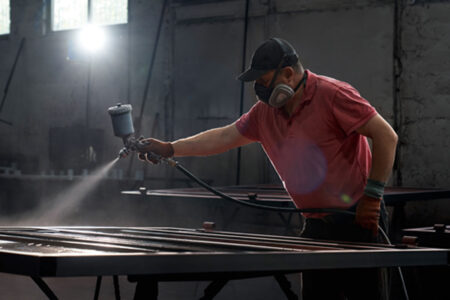
How to choose a primer for metal
Why Prime Metal at All? Imagine you painted a metal gate, and by the very next spring, the paint started to blister and peel. The most likely reason is that the surface wasn't primed. Without a primer, paint has a …
Primer for metal Delfi
Primer for metalповністю
Flow calculator
Consumption standard of 1 layer
When calculating the area to be painted, you need to subtract the area that will not be painted. (windows, doors, etc.)
Paint consumption may vary depending on dilution and uniformity of application of the paint.