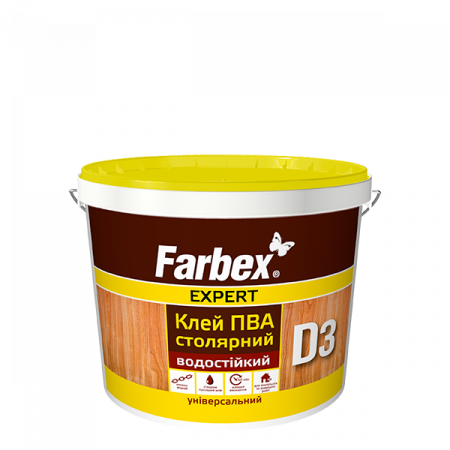
Specification
This glue meets the durability class of D3 (DSTU EN 204). It provides a high setting speed for the materials to be bonded and gives an excellent bonding strength. It forms a strong, flexible and transparent adhesive seam.
Sphere of application
It is intended for reliable gluing all types of wood, furniture, wooden constructions, MDF, flakeboard, fiberboard, plywood, parquet and laminated floors, lino, surfacing material, foam polystyrene, paper, carton, gypsum plasterboard, and also textiles.
For exterior and interior use.
It is recommended for products, which are operated under normal and high humidity conditions (kitchens, bathrooms, basements, pantries, balconies). It is not intended for materials that are permanently affected by water. Exterior works are allowed but with compulsory protection of joint parts with a coat of paint or varnish.
Content
Technical data
| Consumption standard of 1 layer | 120-180 g/m2 |
| Thinner | Water. The glue is ready to use and it doesn't need diluting. |
| Application | With a brush, a roller or an applicator |
| Drying period (23 °С, 50% RH) | 1 hour. Drying period increases if the temperature is getting down and relative air humidity is increasing and also depends on the type of the surfaces to be glued. |
| Solids content (DSTU ISO 3251) | 50±2 % |
| Density (DSTU ISO 2811-1) | ≈ 1,1 г/см3 |
| Adhesive durability class (DIN EN 204) | D3 (waterproof) |
| 5 – 10 minutes | |
| Adhesive strength, MPa | > 10 MPa, after 7 days of drying at a temperature of 23 °C and a relative humidity of 50%. |
| Warranty period | 18 months |
| Packaging | 0,5 kg, 1 kg, 2,5 kg, 4,8 kg |
Color
Application instruction
The condition for receiving a desired result is following directions for using the paint product and preparing the surface.
1. Surface preparation
The surface, which is meant to stick, must be dry – the timber humidity must be from 8% to 12%. The timber must be clean from dirt, dust, paint products, grease, oily, resin, biological, and other contaminations.
In case there are deposits of resin on the surface of the wood, they must be removed mechanically (with a spatula or a scratcher). Then clean these areas with water and detergents or universal thinner TM Maxima.
In case the wood is infected with blue stain, mould, or fungi, remove infected areas: first mechanically and then treat the wood with antiseptic for wooden surfaces TM Farbex. Correct uneven surfaces with stucco TM Farbex. Polish the corrected surface and then dust it off.
Smooth (glossy) surfaces must be grinded and then dusted off. It is necessary for better adhesion with the product.
The surfaces, which are going to be stuck, must be perfectly matched to each other. Big gaps between the surfaces cause increasing the period of hardening of the adhesive seam and reducing of its hardness.
Before using subordinate products (antiseptics, stucco, etc.), it is necessary to check compatibility on a small area of the surface, following technical directions or specialists’ advice.
2. Priming
We do not recommend priming before applying the adhesive.
3. Using
We do not recommend diluting the adhesive. Adhesive diluting reduce hardness of the adhesive connection.
Stir the product thoroughly before use.
Carry out sticking at the temperature of air and the surfaces from +15 °С till + 25 °C, and relative air humidity from 40% till 70%. If the temperature is low, the adhesive sticks to the surfaces much longer. If the temperature is high (above + 25 °С) the moisture evaporates too quickly, and the adhesive does not manage to stick well, and the hardness of the adhesive seam can be reduced.
Apply it with a thin and homogeneous layer on both sides. Join the details and press them with pressure 1-5 kg/cm2, after you apply the adhesive. Keep pressure for 10-20 minutes. The surfaces of hard species of wood and uneven surfaces must be kept under pressure for up to 50 minutes.
Remove excess glue with a wet cloth or sponge.
Attention! The glue consumption, time, and pressure force, hardness of the adhesive seam, and adhesive effect on the wood substantially depend on the species and age of the wood. When you work with hard and exotic species of wood, you must test adhesion following all directions.
When you work with a great number of details and/or for a long period, we do not recommend keeping the container with the products open for a long time.
Do not carry out sticking under direct sunlight, strong wind, or precipitation. After you stick the details, the seam must not be affected by precipitation for 24 hours.
The adhesive seam becomes fully hard and water-resistant after 7 days.
If you use the adhesive outdoors, protect the adhesive seam with the appropriate paint products.
The tools, which you use for applying the adhesive, must be recommended for water-based products or made of plastic or stainless material.
For a quality result, you have to obtain the skills for sticking to and carrying out carpentry work.
After sticking, the wooden surfaces can be chipped and affected by dust, etc.
After sticking all existing (nails, staples, screws, and others) elements must be made of zinced or stainless steel. If you use iron elements for wooden constructions, they must be protected against corrosion with special primers or other products.
POLYSAN company recommends doing personal testing for compatibility of the products and the hardness of the adhesive seam.
Compatibility with other coatings
Depending on the exploitation, the glue can be used with different finishing coatings. The examples of compatibility are given below. Call the specialists of POLYSAN for detailed recommendations.
Previous layer – we recommend applying it on a clean surface.
Subsequent layer – water-based paint products.
The compatibility of products is recommended to be tested on a small area of the surface.
4. Tool cleaning
Clean the tools with water after the work. Do not let them get dry. The rest of the dry glue can be removed mechanically.
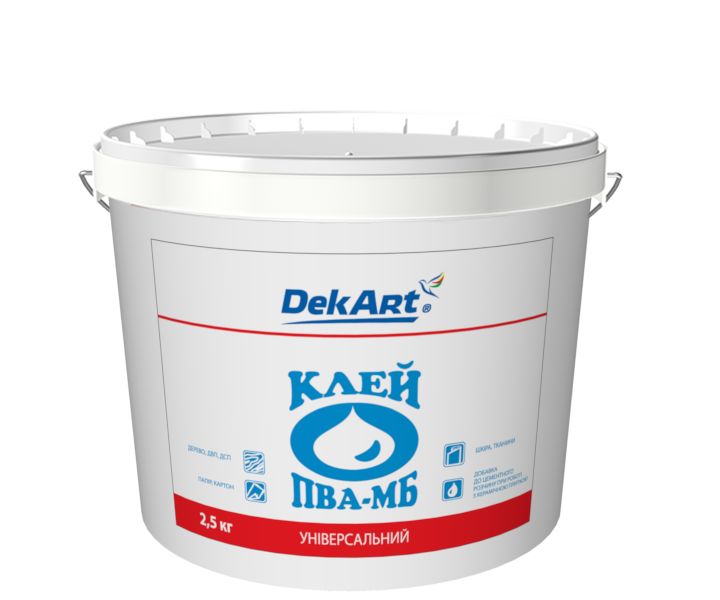
Use with this product
PVA glue Farbex
PVA glueповністю
Flow calculator
Consumption standard of 1 layer
When calculating the area to be painted, you need to subtract the area that will not be painted. (windows, doors, etc.)
Paint consumption may vary depending on dilution and uniformity of application of the paint.