Acrylic primer, what is it for, how to choose and apply it correctly
Priming is one of the main stages of surface preparation before painting, applying putty or plaster, hanging wallpaper, or carrying out other finishing work. A properly selected primer strengthens the substrate, evens out its absorbency, and improves the adhesion of subsequent materials to the surface. Many people skip this step to save time or money, assuming that the paint will adhere properly anyway. However, this is one of the most costly mistakes you can make during renovation.
Priming is particularly important for porous mineral substrates such as concrete, brick, plaster, plasterboard, aerated concrete, foam concrete, and cement-sand surfaces. Without preliminary preparation, these materials may absorb water from paint, putty, or adhesive unevenly, which increases the consumption of finishing materials and reduces the quality of the coating.
One of the most common solutions for such applications is a deep-penetrating acrylic primer.
What Is an Acrylic Primer?
An acrylic primer is a water-based dispersion formulated with an acrylic dispersion and applied to a prepared surface before subsequent finishing work. This is usually what people mean when they simply refer to a “wall primer.”
After application, the primer penetrates the pores of the mineral substrate and helps to:
- strengthen the surface layer;
- reduce and even out water absorption;
- improve the adhesion of subsequent materials;
- reduce the consumption of paint and other finishing materials;
- prepare the substrate for painting, puttying, plastering, wallpapering, or tiling.
It is important to understand that a standard acrylic primer is neither a waterproofing product nor an antiseptic treatment. If fungus or mould is present on the surface, the affected areas must first be cleaned and then treated with a special antiseptic product intended for mineral surfaces. Priming can only begin after the surface has been properly prepared.
Why Is a Primer Needed?
Strengthening the Substrate
Mineral surfaces may have a porous or insufficiently strong structure. The primer penetrates the upper layer of the substrate and helps to strengthen it. This is particularly important for old plaster, aerated concrete, foam concrete, and other highly absorbent materials.
Evening Out the Absorbency
Even a single wall may absorb moisture unevenly. For example, areas covered with putty, plaster, and concrete have different structures. Priming helps to even out water absorption across the entire surface, allowing the next material to dry more uniformly.
Improving Adhesion
An acrylic primer creates optimum conditions for adhesion between the substrate and the subsequent finishing layer. This is important before applying paint, putty, plaster, wallpaper adhesive, or tile adhesive.
Reducing Paint Consumption
On a highly absorbent surface, part of the liquid phase of the paint quickly penetrates the pores of the substrate. Proper priming reduces and evens out absorbency, allowing the paint or coating material to spread more uniformly.
Which Surfaces Are Suitable for Acrylic Primer?
Deep-penetrating primers for mineral surfaces are used to treat:
- concrete;
- brick;
- cement and cement-sand plaster;
- putty;
- plasterboard;
- cinder block;
- aerated concrete;
- foam concrete;
- cement-sand screeds;
- other porous mineral materials.
The specific scope of application depends on the product, so always check the manufacturer’s technical specification before beginning work.
Standard primers intended for mineral surfaces should not be used on wood or metal. These substrates require specialised wood-protection, adhesion-promoting, or anti-corrosion primers.
Types of Acrylic Primers
Ready-to-Use Primers
These primers do not require preliminary dilution with water. They only need to be thoroughly mixed before application. Ready-to-use primers are convenient for small and medium-sized projects because there is no need to prepare a working solution or determine the correct ratio of concentrate to water.
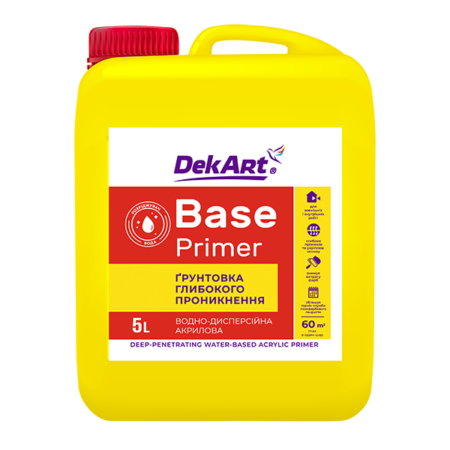
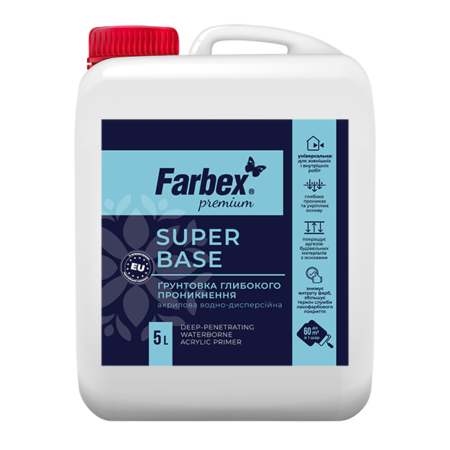
Examples include Super Base Farbex and Base DekArt.
Primer Concentrates
Before use, the concentrate is diluted with water according to the type and absorbency of the surface. The advantage of this solution is that a large volume of ready-to-use primer can be obtained from a smaller quantity of concentrate.
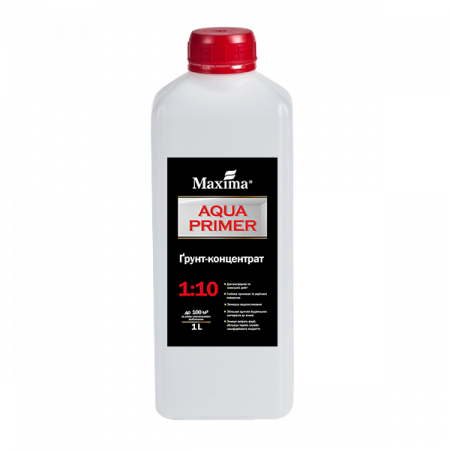
- Aqua Primer Maxima — a concentrate with a maximum dilution ratio of 1:10;
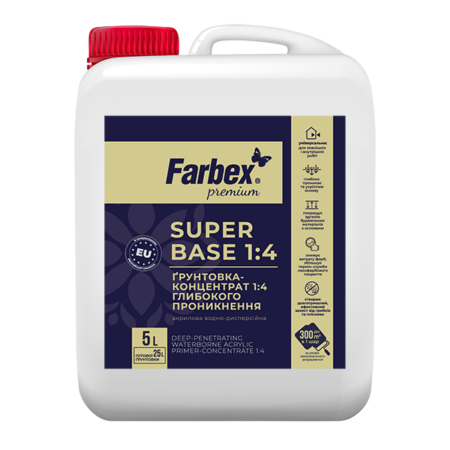
- SuperBase 1:4 Farbex — a concentrate with a maximum dilution ratio of 1:4;
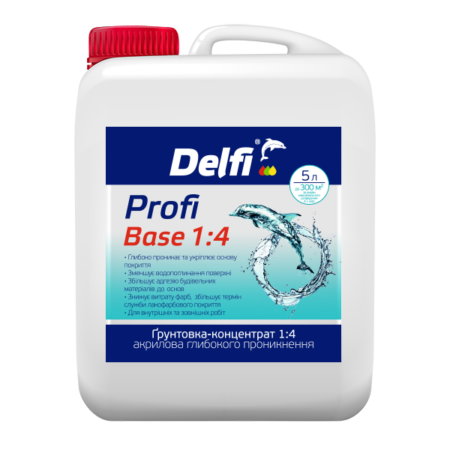
- Profi Base Delfi — a 1:4 concentrate.
A designation such as “1:10” or “1:4” does not mean that the product must always be diluted at the maximum ratio. The concentration of the working solution depends on the absorbency of the specific substrate.
How to Choose an Acrylic Primer
For highly porous surfaces — aerated concrete, foam concrete, old plaster, and other highly absorbent substrates require a primer with strong penetrating and strengthening properties. Such surfaces may require a more concentrated working solution and two coats of primer.
For concrete and brick — dense mineral surfaces absorb significantly less water. For these surfaces, the concentrate can be diluted to a greater extent, but only within the ratios specified by the manufacturer.
For plasterboard and plaster — these surfaces usually have medium absorbency. Priming is particularly important before painting or applying subsequent coats of putty.
For large areas — when renovating a house, apartment, commercial premises, or facade, a concentrate is often a practical solution. For example, SuperBase 1:4 Farbex allows the dilution ratio to be adjusted according to the surface type, with a maximum recommended ratio of 1:4.
For small projects — if you need to prime a single room or a small area, it is easier to use a ready-to-use product such as Super Base Farbex.
How to Apply Acrylic Primer Correctly
Step 1. Prepare the Surface
The substrate must be sound, dry, and clean. Remove dust, chalk and lime whitewash, grease and oil contamination, efflorescence, remnants of peeling old coatings, wallpaper and adhesive residue, as well as loose areas of plaster. Always remove all dust after sanding putty. If fungus or mould is present, the affected areas must be mechanically cleaned and treated with an appropriate antiseptic product. Before priming, the moisture content of cement and cement-sand substrates must not exceed 5%, while the moisture content of gypsum substrates must not exceed 1%.
Step 2. Prepare the Primer
Thoroughly mix a ready-to-use primer. Dilute a concentrate only in accordance with the instructions for the specific product.
For Aqua Primer Maxima 1:10, we recommend:
| Surface Type | Recommended Dilution |
| Extremely weak and crumbling surfaces | 1:4 |
| Very weak and highly absorbent surfaces, including aerated concrete and foam concrete | 1:6 |
| Surfaces with medium absorbency, including plaster and plasterboard | 1:8 |
| Surfaces with low absorbency, including concrete and brick | 1:10 |
DO NOT use Aqua Primer without dilution.
SuperBase 1:4 Farbex requires a different dilution scheme:
| Surface Type | Recommended Dilution |
| Extremely porous and crumbling surfaces | undiluted |
| Aerated concrete, foam concrete, and other highly absorbent surfaces | 1:1 |
| Plaster, plasterboard, and other surfaces with medium absorbency | 1:2 |
| Concrete, brick, and other surfaces with low absorbency | 1:4 |
Therefore, there is no universal rule stating that “every primer must be diluted 1:4.” The specific product and type of substrate must always be taken into account.
Step 3. Choose the Application Tool
Acrylic primers can be applied using a roller, brush, or paint sprayer. For large, even surfaces, a roller and paint tray are the most convenient choice. A brush is suitable for corners, joints, and hard-to-reach areas.
Step 4. Apply the First Coat
Apply the primer evenly without leaving untreated areas, puddles, or excessive accumulations of material. Do not attempt to saturate the surface as much as possible in a single pass. Excessive primer application, sometimes referred to as “over-priming,” is also undesirable. When working with a new or unfamiliar substrate, it is advisable to perform a test application on a small area first.
Step 5. Determine Whether a Second Coat Is Required
One even coat may be sufficient for most properly prepared substrates. We recommend treating highly absorbent surfaces with two coats, allowing approximately 2 hours of intermediate drying time under normal conditions.
Step 6. Wait Before Applying the Finish Coat
At a temperature of approximately +23 °C and a relative humidity of 50%, many acrylic primers take approximately 2 hours to dry. However, the drying time increases at lower temperatures, higher humidity, and higher application rates. We recommend beginning subsequent finishing work no earlier than 4 hours after applying the final coat.
At What Temperature Can Primer Be Applied?
We recommend carrying out the work when the air and surface temperatures are between +10 °C and +30 °C and the relative humidity does not exceed 80%.
Exterior priming should not be carried out:
- in direct sunlight;
- during strong winds;
- in the rain;
- in freezing conditions.
The surface must be protected from precipitation and sub-zero temperatures until the finish coat has been applied.
How Much Primer Is Required per 1 m²?
The exact consumption depends on the structure, material, and absorbency of the substrate, as well as the application method.
- Aqua Primer Maxima — 100–150 g/m² of ready-to-use diluted solution per coat;
- SuperBase 1:4 Farbex — an approximate application rate of 80–125 ml/m² of ready-to-use material per coat, depending on the substrate;
- Super Base Farbex — 80–125 ml/m²;
- Profi Base Delfi — 80–125 ml/m².
The actual consumption and number of coats may be higher on highly porous substrates.
Our Primers
Aqua Primer Maxima 1:10 Primer Concentrate
Super Base Farbex Primer
SuperBase 1:4 Farbex Primer Concentrate
Profi Base Delfi is a 1:4 deep-penetrating acrylic primer concentrate for exterior and interior applications.Base DekArt is a ready-to-use, deep-penetrating acrylic primer for mineral surfaces.
Comparison of Acrylic Primers
| Product | Type | Maximum Dilution | Main Application | Key Feature |
| Aqua Primer Maxima | concentrate | 1:10 | mineral surfaces | wide dilution range from 1:4 to 1:10 |
| Super Base Farbex | ready-to-use | not diluted | mineral surfaces | ready to use |
| SuperBase 1:4 Farbex | concentrate | 1:4 | mineral surfaces | can be used undiluted or diluted up to 1:4 |
| Profi Base Delfi | concentrate | 1:4 | mineral surfaces | economical concentrate |
| Base DekArt | ready-to-use | not diluted | mineral surfaces | simple ready-to-use option |
A primer should not be selected according to a general “better/worse” assessment. The choice should be based on the surface type, required concentration, project area, and compatibility with the subsequent material.
Therefore, an acrylic primer is an important part of properly preparing mineral surfaces before painting and other finishing work. It strengthens the substrate, evens out its absorbency, improves adhesion, and helps ensure the efficient use of subsequent materials.
If large areas need to be primed and the concentration must be adjustable according to the surface, Aqua Primer Maxima 1:10 can be selected. SuperBase 1:4 Farbex also allows the dilution ratio to be adjusted over a wide range. If a ready-to-use material is required, Super Base Farbex is a convenient solution.
The main rule is to select a primer that matches the specific type of substrate and to follow the product’s technical specification. A properly prepared, clean, and dry surface, the correct dilution ratio, and sufficient drying time create a reliable base for subsequent finishing.
Read more
25.08.2026